What If Dewey Had Defeated Truman in 1948?

On the evening of November 2, 1948, America’s newsrooms confidently prepared for what seemed inevitable: Thomas E. Dewey’s victory over Harry S. Truman in the U.S. presidential election. Radio commentators and pollsters had spent weeks predicting the Republican governor’s triumph. The media’s certainty was so complete that some newspapers even went to press before final results were tallied, and on November 3, the Chicago Daily Tribune famously ran with the headline “DEWEY DEFEATS TRUMAN.” Yet, in one of the greatest upsets in American political history, Truman defied the odds, winning 303 electoral votes to Dewey’s 189.
The photograph of a grinning Truman holding up the erroneous Tribune headline became an iconic symbol of journalistic overconfidence. But what if the media had been right? How might things be different if Dewey had actually won the presidency in 1948?
A Difference of Style
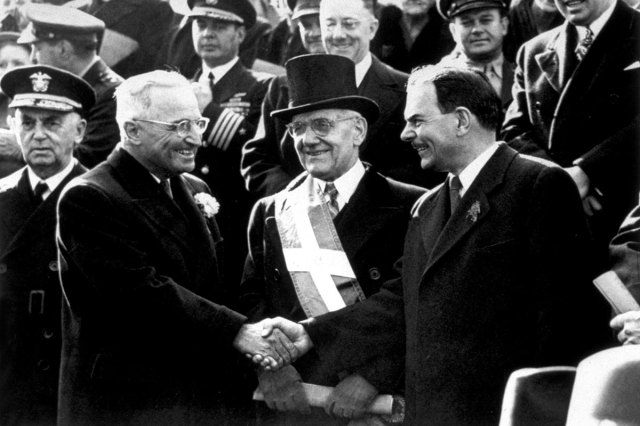
With Truman’s victory, the Democrats retained the White House and took control of the Senate and the House of Representatives. But if the pollsters had been correct and the Republican candidate had won, the most obvious and immediate difference in the White House may have been one of character.
In an interview with History Facts, historian A.J. Baime — author of The Accidental President: Harry S. Truman and the Four Months That Changed the World — pointed out how a Dewey presidency would have brought a fundamentally different personality to the White House. According to Baime, Truman was a comparatively down-to-earth, plain-speaking individual who drank bourbon, loved poker, and represented “the greatest manifestation of the common American man.” Dewey, on the other hand, had a stiffer demeanor and came across as more distant in public — a man, Baime said, who “drank gin and spoke in platitudes, in a deep baritone trained singing voice.”
Dewey played bridge and used his sharp, analytical mind to ponder issues of wider society rather than connect with the individual voter. While he was admired by many for his intelligence and integrity, he did not have Truman’s warmth — and this obvious difference of style, Baime said, “meant something to the American people and still means something to the American people.” It’s hard to say how these personality differences may have altered U.S. history, though. Dewey’s potentially more measured, deliberate approach to communication might have provided steadier leadership during times of crisis, but he may have lacked the populist appeal of Truman that resonated with ordinary Americans.
Domestic Policy
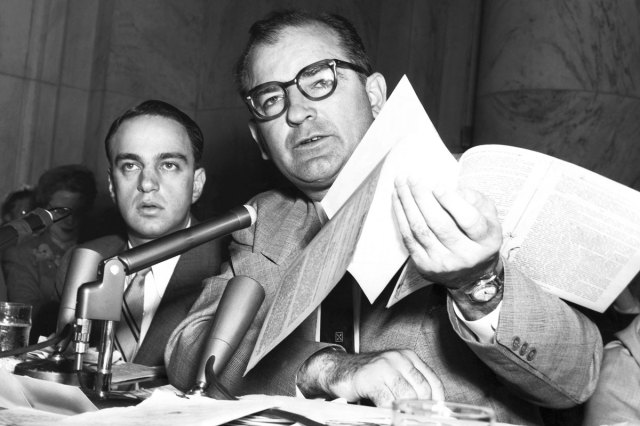
One of the most notable differences between Dewey and Truman would likely have been how they handled Senator Joseph McCarthy’s anti-communist crusade. Truman’s often reactive approach to McCarthyism allowed the senator to dominate headlines and spread fear throughout American society. Some political historians have criticized Truman’s actions on this issue, arguing that he responded too slowly and weakly to McCarthy.
Baime said he believes Dewey could have handled McCarthyism better than Truman, in part because Dewey was a trained attorney and a cutthroat prosecutor and debater. According to Baime, there’s an argument to be made that “the ’50s Red Scare might not have been as scary as it was, if Dewey were president.” With his prosecutorial background and understanding of legal procedure, Dewey might have been better equipped to counter McCarthy’s tactics and challenge the senator’s often evidence-free accusations, while still maintaining a strong anti-communist stance.
In terms of economic policy, Truman and Dewey had differing views on the relationship between government and business. Dewey, who had close ties to big business in New York, was Wall Street’s preferred candidate, and stocks rallied with his predicted victory. Truman had an arguably more complex relationship — he wasn’t afraid to speak out against corporate greed and the perceived dangers of excessive financial speculation — and in 1948 he railed against “privileged Wall Street gluttons.” According to Baime, “Truman feared that if he were not in the White House, Wall Street would become too powerful at the expense of the common man.” Dewey, on the other hand, “was an excellent and highly regarded governor of New York with deep relationships with the power elite.” Baime said he thought Dewey would have allowed Wall Street and big business more leeway, which in turn would have given the wealthy more power — but, he noted, not to the degree that Truman feared.
On the issue of civil rights, the differences between Dewey and Truman were more subtle. Truman’s decision to desegregate the military in 1948 was a bold move that helped define his presidency. Dewey, while considered a progressive Republican governor of New York, represented a party with different regional dynamics, and he might have approached civil rights more cautiously, pursuing a more incremental approach.
Foreign Policy
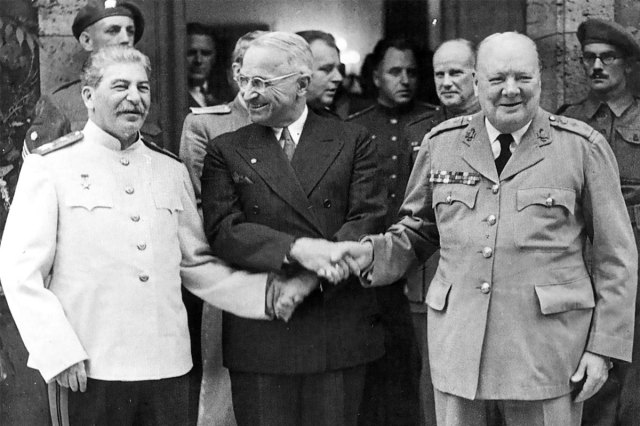
Despite their differences in style and domestic priorities, both Truman and Dewey shared fundamental assumptions about America’s role in the world. Both, for example, believed the U.S. should play an active role in international organizations such as the United Nations (rather than retreat into isolationism), and both considered it necessary to contain the spread of communism. When it came to foreign policy, the two men were often aligned. “I believe that foreign policy would not have been much different,” Baime said, “and that the Korean War and the Cold War would have moved along in a very similar fashion.”
Baine argued that no president could have solved “1950s conundrums like Soviet aggression, nuclear proliferation, the early posturing that later turned into the Vietnam War, the conflict in the Middle East, and Korea.” A lot of the major problems the country faced, he said, “are still with us today precisely because they appear to be so unsolvable, no matter who is president.”

An America Without Ike
There’s an argument to be made, therefore, that the fundamental challenges of the era would have remained largely unchanged even if Dewey had defeated Truman. But speaking to History Facts, Jeffrey Frank, author of The Trials of Harry S. Truman, pointed out one intriguing aspect of this theoretical discussion: the 34th U.S. president, Dwight D. Eisenhower.
“Alternative history is fun,” Frank said, “because there are so many forks in so many roads. But I would start with this basic assumption: If Dewey had won, Eisenhower would never have run for president in 1952 (he always said he didn’t want the job anyway), when Dewey would be running for a second term.” This alone would have brought about a major change. Among his many achievements, Eisenhower strengthened the Social Security program, increased the minimum wage, created the Department of Health, Education, and Welfare, and signed the Civil Rights Act of 1957. He also negotiated an armistice in the Korean War, and managed to maintain peace during the crisis-filled 1950s. “Try to imagine the future of the GOP and the USA without Ike,” Frank said. “For me, not a happy thought.”


Comments
Post a Comment