Where Did the Heart Symbol Come From?

We recognize it instantly: two rounded lobes meeting at a point, the universal symbol of love. The heart shape is found everywhere — on greeting cards, jewelry, bumper stickers, and emoji keyboards. It even stars in tourism campaigns such as “I ❤ NY” and drives the $27.5 billion Valentine’s Day industry. But while the symbol represents deep emotion, it looks nothing like an actual human heart. So where did the symbol come from? The answer lies in a long history shaped by philosophy, nature, and art.

It Evolved From Ancient Beliefs
The familiar heart shape we recognize today wasn’t inspired by the anatomy of the human heart — it evolved from ancient beliefs about what the heart represented. Long before modern science defined the purpose of the heart, cultures across the world viewed the organ as the center of emotion, thought, and even the soul. Ancient people had little understanding of the importance of the brain, but they could feel the heart beating rapidly when emotions were heightened and understood the organ’s vital connection to sustaining life.
In ancient Egypt, the heart was believed to hold a person’s essence — including memory, intellect, and morality. Embalmers often left the heart inside the body or preserved it with special care, considering it far more important than the brain. Later, in Greek philosophy, Aristotle described the heart as the source of sensation and life itself. He believed it was the first organ to form in an embryo and the center of human emotion. The brain, in his view, existed only to cool the heart’s fiery temperament.
Five centuries after Aristotle, the Roman-era physician and philosopher Galen brought a more anatomical perspective to the discussion. He believed the heart was a pine cone-shaped three-chambered organ that produced the body’s vital spirit — a life-sustaining force carried through the arteries. Many of his ideas were inaccurate, inspired by philosophical tradition and limited scientific observation. With little access to human dissection, early artists and illustrators relied on metaphor, creating stylized, symmetrical shapes that reflected the heart’s symbolic role in the soul rather than its actual anatomy.

The Symbol Is Found in Nature
In geometric terms, the heart shape is known as a cardioid, and forms resembling it can be found throughout the natural world. In fact, one of the most compelling theories about the origin of the heart symbol points to ancient agriculture and the symbolism of plants, rather than human anatomy.
In the ancient city of Cyrene (modern-day Libya), a species of giant fennel known as silphium was so highly valued that it drove the economy of the region. Its uses were wide-ranging: Silphium was a prized seasoning, a powerful medicine, and, most notably, a natural contraceptive. It was so essential to life and love in the ancient world that it was stamped onto Cyrenian coins.
The plant’s seedpod, in particular, bore a strong resemblance to the heart symbol we recognize today — a smooth, symmetrical form tapering to a point. Because silphium was closely associated with love, sexuality, and fertility, some historians believe the shape of its seedpod may have directly influenced the development of the symbolic heart.
Other plants have also echoed the heart’s curves. Ivy leaves, long associated with fidelity and eternal love in Greek and Roman symbolism, display a heartlike silhouette. The fig leaf, tied to sensuality in ancient art and myth, and even water lily leaves, often shaped like rounded hearts, may have subtly reinforced the motif in art and decoration.
It Took on a Romantic Meaning in the Middle Ages
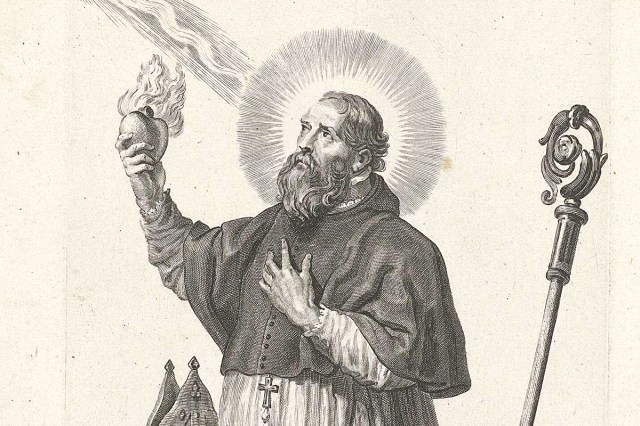
By the Middle Ages, the symbolic heart began to appear more frequently in religious art and literature in Europe, often representing divine or spiritual love. In Christian iconography, saints such as St. Augustine were depicted holding or pointing to flaming hearts, symbolizing their devotion to God. The Sacred Heart of Jesus, which emerged in medieval devotional art, emphasized themes of love, sacrifice, and compassion — establishing the heart as a spiritual symbol.
At the same time, more secular interpretations of the heart were gaining popularity. In illuminated manuscripts from the 13th and 14th centuries, lovers were sometimes shown exchanging hearts — both literally and metaphorically. A notable example appears in the 14th-century French manuscript Roman de la Poire (“Romance of the Pear”), in which a man offers his heart, shaped much like the modern symbol, to his beloved. These early heart illustrations were often red, symmetrical, and stylized — but they didn’t always follow today’s orientation. Some were shown with the point facing upward, while others were more angular or leaflike.

The Printing Press Helped Solidify the Symbol
The invention of the printing press in the 15th century helped standardize and spread the heart symbol across Europe. As printed materials became more widely available, so did visual motifs — and the heart, already associated with courtly love and devotion in art, literature, and music, was a popular choice. Early printers used woodcuts to embellish books and pamphlets with heart shapes in religious texts, emblems, and romantic illustrations. Around the same time, in 1498, Leonardo da Vinci created one of the first anatomically accurate drawings of the human heart — but his scientific rendering had little influence on the romanticized symbol already taking hold in popular culture.
As Valentine’s Day evolved into a romantic holiday in England and France, printers began mass-producing cards and tokens adorned with cupids, flowers, and heart motifs. In the 18th and 19th centuries, the heart was everywhere — on embroidery, porcelain, stationery, and jewelry. In the Victorian era, heart-shaped lockets and lace-trimmed valentines became cherished expressions of sentiment. No longer tied to anatomy or philosophy, the heart symbol fully transformed into a visual shorthand for love and emotional connection — a role it still plays today in greeting cards and text messages around the world.


Comments
Post a Comment