What’s the Real Story of Isaac Newton and the Apple?
It’s one of the most iconic images in scientific history: Isaac Newton is sitting beneath an apple tree when a piece of falling fruit hits him on the head, sparking his revolutionary theory of universal gravitation. The tale has been told in countless textbooks and popular accounts, and has become a metaphor for “eureka” moments and the process of scientific discovery in general.
But did an apple actually fall on Newton’s head? Or is this account a fanciful fiction that attached itself to the story of Newton’s brilliant scientific and mathematical insights? Here, we take a closer look at the well-known tale of Newton and the falling apple, and the truth behind one of history’s greatest scientific discoveries.
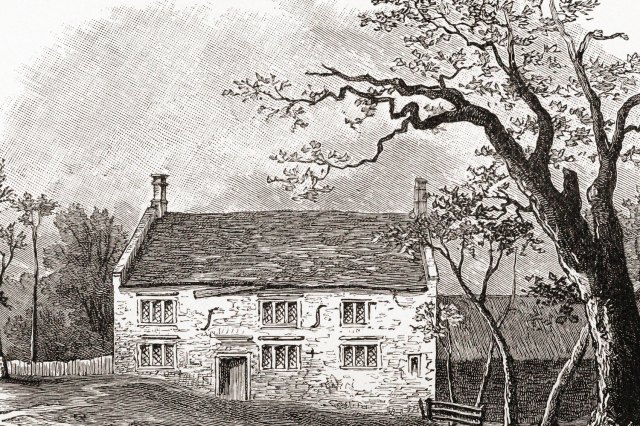
The Story of the Falling Apple

Isaac Newton’s Own Account
This story wasn’t plucked out of thin air: The now-legendary moment was based on Newton’s own account, which he told to several acquaintances near the end of his life. Among the first people was his niece Catherine Barton (later Catherine Conduitt). Barton then recounted the story to others, including French Enlightenment philosopher Voltaire, who briefly mentioned the incident in his 1727 Essay on Epic Poetry: “Sir Isaac Newton walking in his gardens, had the first thought of his system of gravitation, upon seeing an apple falling from a tree.”
The previous year, in 1726, Catherine Barton’s husband, John Conduitt, also referenced the incident in his notes, writing how Newton first came upon his “system of gravitation… by observing an apple fall from a tree.”
The most detailed contemporary account comes from William Stukeley, an archaeologist and one of Newton’s first biographers. In his Memoirs of Sir Isaac Newton’s Life (published in 1752), Stukeley related a conversation he had with Newton, a year before the scientist’s death in 1727: “We went into the garden, and drank thea under the shade of some apple trees, only he, and myself. Amidst other discourse, he told me, he was just in the same situation, as when formerly, the notion of gravitation came into his mind. ‘Why should that apple always descend perpendicularly to the ground,’ thought he to himself: occasion’d by the fall of an apple, as he sat in a contemplative mood: ‘Why should it not go sideways, or upwards? But constantly to the earth’s centre?’”
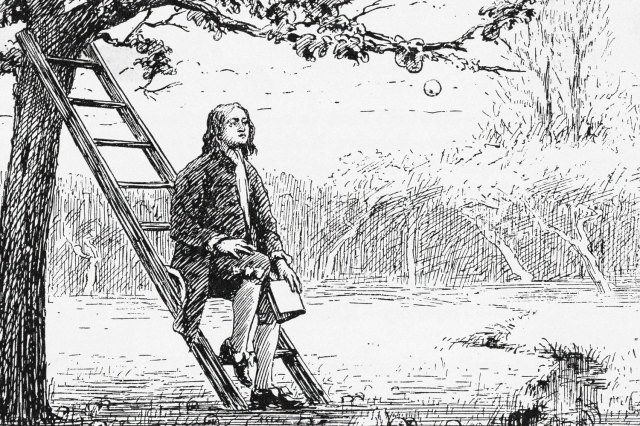
An Apple Likely Fell, But Not on Newton’s Head
From these accounts, there’s strong evidence to suggest that Newton did indeed tell a number of acquaintances about how a falling apple helped form his theory of universal gravitation. But while the moment is often presented as a true epiphany, exactly how much an apple inspired Newton is open to debate, and we can’t know to what extent the falling fruit informed his scientific thinking.
Some academics — most notably John and Mary Gribbin in their book Out of the Shadow of a Giant: Hooke, Halley, and the Birth of Science — have argued that Newton made up the apple story altogether, possibly to support his claim that he had the idea of a universal theory of gravity before Robert Hooke, who famously accused Newton of plagiarism.
One part of the story that has no supporting evidence — despite being a popular aspect of the tale — is the apple actually falling right on Newton’s head. This seems to be nothing more than a later embellishment, yet one that has managed to become engrained in popular culture up until the present day.


Comments
Post a Comment