What’s the Real Story of Ben Franklin’s Kite Experiment?

It’s one of the most well-known moments in American history: Ben Franklin attaching a key to a kite during a thunderstorm to demonstrate the electrical nature of lightning. Yet, like a centuries-long game of telephone, the details of the celebrated 1752 experiment have been exaggerated or misinterpreted through countless retellings, creating a popular myth that may be more fiction than fact.
Look no further than the oil-on-canvas work “Benjamin Franklin Drawing Electricity From the Sky,” painted by Benjamin West in the early 19th century. In the painting, a confident Franklin raises his fist to receive a charge from a key suspended by a kite string, hair and cape billowing around him, as a team of cherubs wrestles with the string and another pair engage with some sort of electrical apparatus in the background.
This work of art encapsulates much of the myth surrounding the famous experiment. The dramatic portrayal clearly isn’t meant to be taken as a historically accurate re-creation, and West took several liberties with his depiction of the event. For one thing, Franklin was actually assisted in this endeavor by his young adult son William, not a team of cherubs. The inventor was also a relatively spry 46 at the time, not yet the wizened elder seen in the painting. And he likely undertook his experiment from the shelter of a shed, as opposed to being exposed to the elements of a thunderstorm.
What’s more, the kite and key story, retold to countless schoolchildren over the past two centuries and often repackaged as Franklin’s “discovery” of electricity, may not have taken place at all. While that’s certainly a more extreme interpretation of what happened, it also underscores the scarcity of verified details about the most famous experiment from one of the most famous figures in American history. So what really happened?
Franklin’s Theories on Electricity
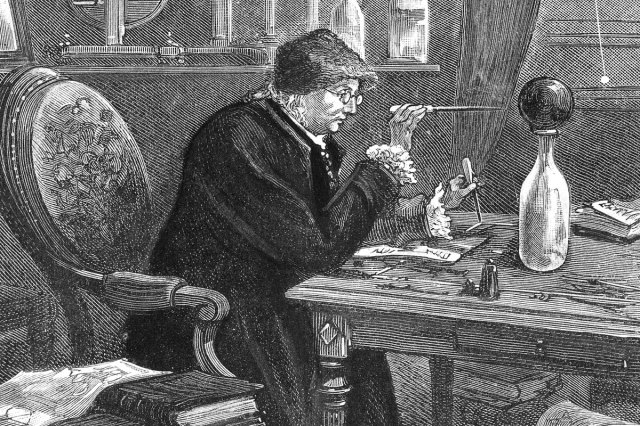
As told in Walter Isaacson’s Benjamin Franklin: An American Life, the titular polymath, then best known as a Philadelphia printer, turned his considerable intellectual gifts toward exploring the little-understood properties of electricity in the 1740s. Conducting an array of experiments with a Leyden jar, a simple capacitor fitted with a cork and wire, Franklin formed what became the single-fluid theory of electricity with his observation of a flow between “positive” and “negative” bodies with an excess or absence of the fluid.
Franklin also became intrigued by the similarities between electrical sparks and lightning, and devised ways in which to demonstrate their shared nature. In a 1749 collection of notes, later relayed in a 1750 letter to Franklin’s London business partner Peter Collinson, Franklin described how such a demonstration could be administered: “On the top of some high tower or steeple, place a kind of sentry-box, big enough to contain a man and an electrical stand. From the middle of the stand, let an iron rod rise and pass bending out of the door, and then upright 20 or 30 feet, pointed very sharp at the end. If the electrical stand be kept clean and dry, a man standing on it when such clouds are passing low, might be electrified and afford sparks, the rod drawing fire to him from a cloud.”
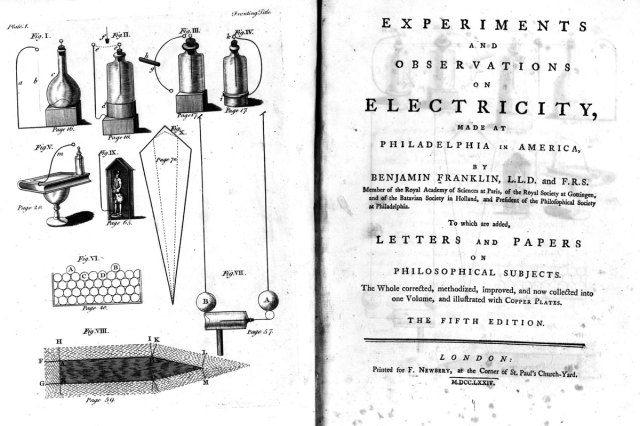
The European scientific community began seriously considering Franklin’s work around this time, particularly after a series of his letters and notes were published in the 1751 pamphlet Experiments and Observations on Electricity. In May 1752, French naturalist Thomas-François Dalibard followed Franklin’s proposed instructions for drawing sparks from a storm cloud, his success inspiring colleagues to produce their own demonstrations that proved the American’s theory that lightning is a form of electrical energy.
The Kite Experiment
Meanwhile, Franklin was impatiently waiting for the steeple of Philadelphia's Christ Church to be completed so he could use its lofty height for his own tests. Apparently unaware of the successes of the "Philadelphia experiments in France, he eventually elected to forgo the steeple and embark on a modified version of his initial plans.
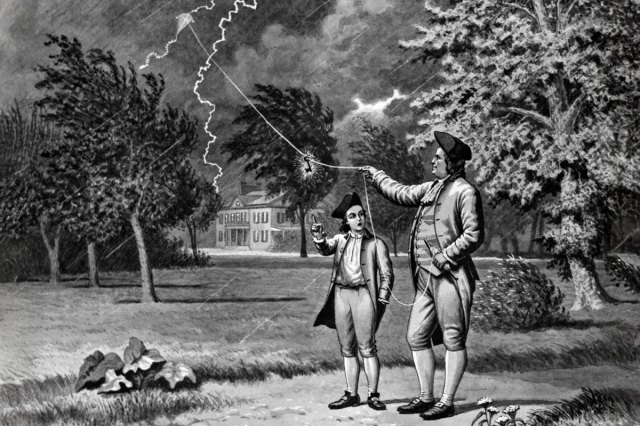
According to contemporary accounts of the event, Franklin and his son William trekked out to a field as a thunderstorm approached in June 1752. They brought a homemade silk kite with a sharp metal wire affixed to the top, a hemp string connected to the bottom, and a metal key attached to the hemp line. Franklin also tied a silk string to the hemp one, surmising that the dry silk would be insulated from the "electric fire" running through the wet hemp line and therefore be safe for holding.
With the kite aloft in the air, Franklin waited for a telltale sign of electrical activity that wasn't apparent until he noticed a few loose threads of the hemp string standing erect. Extending his hand toward the key, he felt the anticipated spark, and held up his trusty Leyden jar to collect more of the charge for later investigations.
Curiously, Franklin provided no immediate documentation of the experience. Even after learning of the French demonstrations sometime that summer, and reprinting a letter about them in a late August 1752 edition of his Pennsylvania Gazette, Franklin neglected to mention that he, too, had proved the electrical properties of lightning.
The first public notice of Franklin's efforts came with a letter he wrote to Collinson that October, which was reprinted in the Pennsylvania Gazette that month and later read before the Royal Society of London. The letter describes how a version of the electrical experiments in France "succeeded in Philadelphia," without mentioning that he was the one who pulled it off, and proceeds to list the steps for following through with his modified plan.
The only other contemporary account of Franklin and his kite came with the 1767 publication of scientist Joseph Priestley's The History and Present State of Electricity. Priestley's retelling, derived from his recent personal introduction to Franklin, provides most of the known plot points of the story: that it took place in June 1752, how the charged threads of the string hovered in the air, and even how the inventor was anxious about being ridiculed and as such told no one besides William of his intentions.
Lingering Questions
Even with the details furnished by Priestley, there remain a few important unresolved questions surrounding this event. For example, we don't know exactly when Franklin sent his kite into the turbulent sky. The date is often cited as June 10, 1752, although other dates in June, and even other months, have been floated. It's also unclear why Franklin himself said so little about the subject, and why his confirmation of the experiment's success failed to place him in the middle of it.
Given the lack of clarity, it was perhaps inevitable that someone would push the theory that it was all a hoax, as suggested by author Tom Tucker with his 2003 book Bolt of Fate. Tucker is in the clear minority in this opinion, however. Other historians have pointed out that Franklin's kite experiment was never disputed at the time, and that he had little reason to lie about his actions after acknowledging that the French beat him to the punch.
Even if the key and kite anecdote can't be proved beyond the existing evidence, there's no arguing that it was Franklin's ideas that opened the pathway to our modern understanding of electricity, and led to the practical — and lifesaving — invention of the lightning rod. In the meantime, the mythical element exemplified by West's painting nicely fills in the holes of a celebrated American origin story, illustrating the ingenuity of one of the cleverest founding fathers.


Comments
Post a Comment